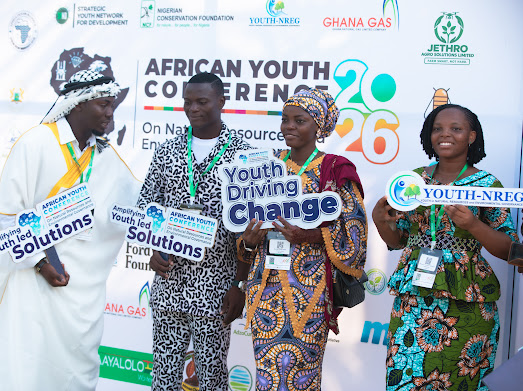
Young Africans have been encouraged to transform their environmental ideas into viable businesses that protect natural resources, create jobs and improve livelihoods across the continent.
The call was made at the African Youth Conference on Natural Resources and Environmental Governance (AYC-NREG) in Accra, which focused on ways to expand youth-led innovations and strengthen Africa’s green economy.
The two-day conference, organised by the Strategic Youth Network for Development (SYND), was held on the theme, “Scaling Youth-led Innovations for Africa’s Green Economy.”
The Director of Communications, Policy and Advocacy at the Nigerian Conservation Foundation (NCF), Mr Kunle Olawoyin, who delivered the keynote address on the second day, said environmental protection must be linked to economic opportunities and community participation.
He said Africa’s forests, wetlands, soils and biodiversity were essential to food security, livelihoods, public health and economic stability.
“A green economy cannot be built on the depletion of natural capital that sustains it,” he said.
Mr Olawoyin said the continent needed to protect its natural resources while creating opportunities for young people and vulnerable communities to earn sustainable incomes.
He cited community-based forest protection, sustainable agriculture, agroforestry and livelihood support programmes in Nigeria as examples of interventions that could combine conservation with economic benefits.
He said young entrepreneurs needed access to finance, technical assistance, appropriate policies and markets to develop their ideas into businesses capable of reaching more people.
Mr Olawoyin also called for stronger collaboration among governments, researchers, financial institutions and private businesses to support promising environmental initiatives.
He said local communities should be regarded as partners in conservation, with young people given opportunities to develop and implement solutions to environmental challenges.
The Executive Director of the Centre for Extractives and Development Africa (CEDA), Mr Samuel Bekoe, said young people continued to face challenges in influencing decisions on natural resource management.
“Being present is not the same as having influence,” he said.
Mr Bekoe called for young people to participate meaningfully in decisions, from setting priorities and developing policies to implementing programmes and assessing their outcomes.
Presenting research on guidelines for youth engagement in natural resource governance, he proposed that institutions establish designated officers to coordinate youth participation and allocate adequate budgets to support the process.
He also recommended transparent procedures for selecting youth representatives, timely access to policy documents, financial assistance to facilitate participation and systems for assessing whether young people’s contributions influenced decisions.
Mr Bekoe said government agencies, traditional authorities, development partners, private businesses and civil society organisations needed formal arrangements that would give young people a meaningful voice in natural resource governance.
The Deputy Director of the National Disaster Management Organisation (NADMO) at the Korle Klottey Municipal Assembly, Madam Esenam Adzo Norgbey Apawu, also urged young innovators to develop solutions that addressed the everyday needs of communities.
According to her, environmental innovations should focus on improving people’s lives, particularly in communities exposed to flooding, disasters and disruptions to livelihoods.
“Think beyond the product. Think about the people whose lives your innovation could change,” she said.
Madam Apawu cited renewable energy and community resilience initiatives as examples of interventions that could help communities and essential services withstand climate-related shocks.
She said young innovators needed to consider how their ideas could provide practical benefits to the people they intended to serve.
The conference also highlighted the importance of partnerships, funding, mentorship, research, infrastructure and market access in helping young people develop and expand environmentally sustainable enterprises.
Participants discussed how stronger support systems could enable young entrepreneurs to move from developing ideas to establishing businesses that contribute to environmental protection and economic development.
The conference, which began as a national gathering in 2023 before expanding into a continental platform, brings together young people and stakeholders to discuss responsible natural resource management, climate action, sustainable livelihoods and Africa’s green transition.