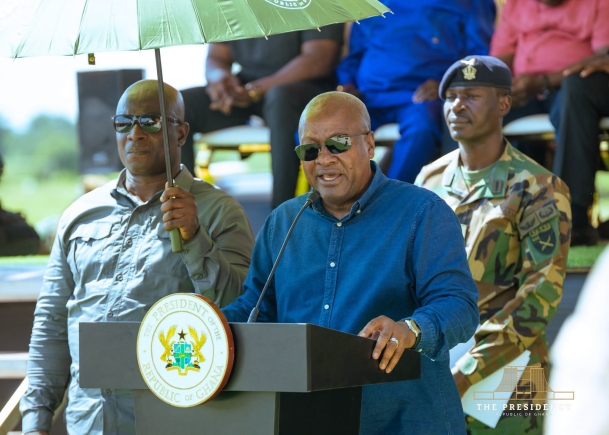
The government is pursuing a five-year strategic plan to strengthen the pharmaceutical manufacturing industry to enable the country to produce a greater proportion of the medicines it currently imports, President John Dramani Mahama has said.
According to him, the initiative is aimed at achieving self-sufficiency in the production of essential medicines while positioning Ghana as a hub for the supply of pharmaceutical products to neighbouring countries.
President Mahama disclosed this last Thursday at a Free Primary Healthcare durbar in Zuarungu in the Bolgatanga East District.
The durbar was part of the President’s Reset Agenda Tour of the Upper East Region.
Reducing import dependence
The President said Ghana currently imported about 70 per cent of the medicines used in the country, despite having the capacity to manufacture many of the drugs locally.
He said the situation placed a significant burden on the country’s health financing system and could affect the availability and affordability of medicines for patients.
“Something very important happened in my office two days ago,” President Mahama said, explaining that representatives of the National Vaccine Institute, the Ministry of Health and allied institutions, including the Pharmaceutical Association of Ghana, had presented a plan to him on how the country could achieve self-sufficiency in drug production.
He said the plan provided a five-year roadmap for expanding the country’s pharmaceutical industry.
“In that plan, when I was listening, we import 70 per cent of the drugs that we use.
But we have the capacity to produce those drugs here ourselves,” he said.
He said the five-year plan would help build the capacity of the pharmaceutical industry and reduce the country’s dependence on foreign suppliers.
President Mahama said the objective was not only to manufacture medicines for domestic consumption, but also to develop the industry to a level where it could export pharmaceutical products to neighbouring countries.
President Mahama said increased local production would have direct implications for the cost of medicines and the government’s ability to provide treatment to citizens.
“If we’re able to do that, it will allow us to procure the drugs at a cheaper cost,” he said.
The President explained that producing medicines locally could reduce the country’s exposure to external supply pressures, while making it easier for the government to provide essential medicines to patients, particularly at the primary healthcare level.
He added that the initiative was particularly important as the government expanded access to care through its preventive healthcare programmes.
Supporting local industry
The government, President Mahama said, was committed to creating the conditions necessary for pharmaceutical manufacturers to expand their operations and produce medicines that met the needs of the Ghanaian population.
The President also linked the initiative to the broader objective of strengthening Ghana’s healthcare system and ensuring that access to medicines was not constrained by cost.
He said the government had already entered into agreements with different drug manufacturing companies to support the supply of medicines while the country worked towards increasing domestic production.
“For now, we’ve signed agreements with different drug manufacturing companies.
And so, we will get those drugs to you,” he said.
The President explained that the arrangements would help provide medicines to patients who were diagnosed with conditions requiring long-term treatment, including hypertension and diabetes.
President Mahama said developing the pharmaceutical industry went beyond meeting domestic needs and aimed to serve export markets, generate foreign exchange and create jobs.
He said the five-year roadmap would help transform the country from a major importer of medicines to a producer and exporter, making health care more sustainable, accessible and affordable.
Free primary care
The Minister of Health, Kwabena Mintah Akandoh, said more than 24,000 pieces of equipment were being distributed nationwide under the Free Primary Healthcare (FPH), including 9,000 health kits, of which 1,320 had been earmarked for the Upper East Region.
He said the FPH programme had started in 150 of the 261 districts, with underserved areas prioritised, and would be extended nationwide by the end of 2028.
NHIS gains
The Deputy Chief Executive Officer (CEO) of the National Health Insurance Authority (NHIA) in charge of Finance and Investment, Anatu Anne Seidu Bogobiri, said the government had cleared GH¢963 million in outstanding provider claims as of April last year.
She said more than GH¢2 billion was paid to providers in 2025, including over GH¢150 million to those in the Upper East Region.
From January to July 2026, Ms Bogobiri said GH¢1.4 billion had been paid nationwide, with Upper East receiving over GH¢100 million.
Active NHIS membership rose from 54 per cent in 2024 to 66 per cent in 2025 and 76 per cent by June 2026, an increase Ms Bogobiri added, reflected improved access and confidence in the National Health Insurance Scheme (NHIS).
She said the government was committed to ensuring that people could access health care regardless of where they lived.
According to her, the NHIS had released GH¢36 million to 107 district facilities to support FPH, and the Upper East Region received about GH¢4.2 million for 14 facilities under the programme.
Credit: Graphic Online