
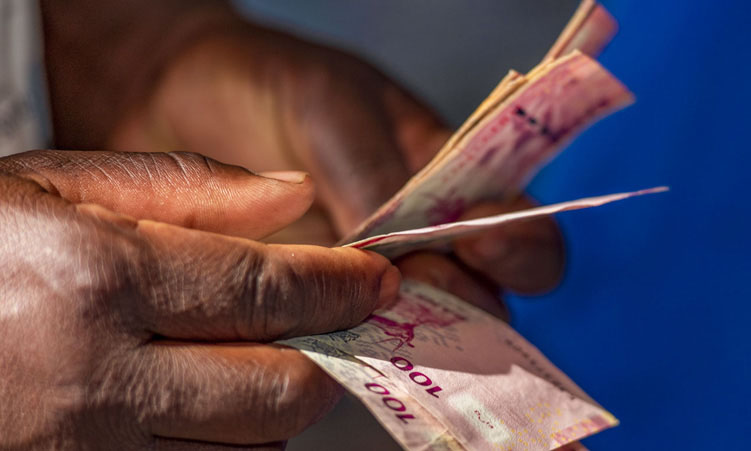
Namibians have turned to banks and microlenders to borrow money to meet their daily household food needs.
The latest Namibia Statistics Agency (NSA) Financial Inclusion Survey has revealed that 546 000 working Namibians have no disposable income and have taken up debt to finance their basic needs.
The survey shows 51.3% of the Namibia’s working population borrows to buy food, while 22.1% borrow to pay for education financial needs and 16.4% borrow to pay for daily transport needs.
Rather than borrowing to buy homes, vehicles or start businesses, thousands of Namibians are taking on debt simply to meet everyday living expenses.
NSA statistician general Alex Shimuafeni says the last nine years saw an upshot in Namibians taking up debt, with borrowing increasingly becoming common.
“Borrowing (both formal and informal) has increased from 42.1% in 2017 to 49% in 2025,” Shimuafeni said while presenting the survey findings yesterday.
The dependence on cash loans is attributed to the low wages experienced by Namibians, who are increasingly struggling to cope with the increasing cost of living in the country.
The NSA states about 295 000 of the 546 000 working Namibians earn less than N$2 000 a month, while only 44 000 people earn more than N$11 000 monthly.
At the same time, household debt continues to grow.
Namibians currently owe about N$7.2 billion to microlenders, while commercial banks are owed more than N$124 billion.
Economists say borrowing for food reveals a deeper economic problem because households are using debt to finance consumption rather than create wealth.
Economist Dirk Haarmann says the findings point to structural weaknesses in Namibia’s economy.
“When people are borrowing simply to put food on the table, this signals structural failure in the economy and not occasional hardship. We are looking at an economy that is failing to provide people with enough income to meet the most basic human need. Daily bread has become, for many, something that can only be obtained on credit,” Haarmann says.
He says borrowing can be useful when households face temporary challenges or unexpected expenses, but food is a recurring cost.
“Food is not a once-off. It is needed every single day. A figure above 50% tells us this is not a temporary blip: for very many people, going short on food is simply the normal state of affairs,” he says.
Unlike borrowing for a house, education or a business, borrowing for food does not create a future income stream.
The meal is consumed today, but the debt remains tomorrow.
POVERTY HAS BECOME PROFITABLE
Economist Claudia Haarmann warns that another consequence of the crisis is the rapid growth of an industry that profits from people’s desperation.
For many households, the problem does not end once the groceries have been bought. The loan still has to be repaid with interest.
Haarmann says this creates a vicious cycle in which struggling families borrow again simply to service previous debts, leaving them with even less money for food the following month.
“Borrowing is never free. Every loan must be repaid, and repaid with more than was taken because of interest,” she says.
She argues that where people borrow matters just as much as why they borrow.
Those forced to rely on informal lenders or loan sharks often end up paying significantly more than those with access to formal financial institutions.
“The more desperate the borrower, the higher the price they are made to pay. An industry has grown around people’s inability to feed themselves. Poverty here is not only suffered, it is also profited from,” Haarmann says.
Rather than solving hunger, she says debt often deepens it.
WEAK HOUSEHOLD RESILIENCE
Economist Jesaya Hano-Oshike says borrowing to buy food indicates that many households have already exhausted their financial safety nets.
“Borrowing to buy food indicates that many households have exhausted their financial buffers and cannot meet basic needs from their incomes alone,” Hano-Oshike says.
He says the problem reflects deeper weaknesses in Namibia’s labour market rather than simply poor financial management.
“This reflects structural weaknesses in the labour market rather than simply poor financial planning. When families rely on credit for essential consumption, they become increasingly vulnerable to debt and unexpected economic shocks,” he says.
Oshike says credit should help households invest and improve their economic position, rather than become a tool for daily survival.
NOT JUST A COST-OF-LIVING CRISIS
While rising food and fuel prices have increased pressure on households, Oshike believes the problem is not temporary.
“The evidence suggests this is largely a structural issue rather than a temporary response to inflation,” he says.
He points to Namibia’s long-standing challenges of high unemployment, inequality and low household incomes.
Many families depend on one income, informal employment or social grants, leaving them vulnerable when prices rise or income is interrupted.
According to Oshike, addressing the crisis requires more than temporary relief measures.
“The government should work closely with the private sector to remove barriers to investment, support business expansion and diversify the economy so that more Namibians have access to stable, productive employment,” he says.
TWO SOLUTIONS, ONE CRISIS
While economists agree that the survey reflects a serious economic challenge, they differ on the best policy response.
The Basic Income Grant Coalition of Namibia argues that a universal income grant could provide households with a basic safety net and reduce dependence on expensive credit.
The coalition says a N$500 monthly grant for every Namibian aged between 0 and 59 would allow people to buy food with dignity while stimulating local economies.
Coalition member Rinaani Musutua, who is also a social activist, says the findings should concern policymakers.
She argues that access to adequate food and dignity are fundamental human rights.
“Namibia needs to accelerate job creation, support small businesses, reduce the cost of living, strengthen social protection, and invest in local food production to reduce dependence on imports. An income grant of N$500 per month for all Namibians aged 0-59 should form part of this response by guaranteeing every Namibian a basic level of income security,” Musutua says.
Hano-Oshike, however, believes sustainable solutions must focus on expanding employment opportunities through private-sector growth.
He says Namibia has advantages such as political stability, infrastructure and access to regional markets, but must create an environment where businesses can invest, expand and hire more workers.
“Many existing restrictions were introduced with the intention of protecting Namibians. However, where these measures unnecessarily increase the cost or complexity of doing business, they can discourage investment, reduce competitiveness and limit the growth of businesses that create employment,” he says.