YEREVAN, May 19 (THE AFRICAN PORTAL) – Armenia is on the verge of parliamentary elections scheduled for June 7. So far, 19 political forces have submitted applications to the country’s Central Election Commission to participate in the vote.
The interim report of the Parliamentary Assembly of the Council of Europe (PACE) on the upcoming elections generally presents a positive assessment of the situation in the republic. However, the reality on the ground appears significantly different from the picture described in the report. Armenian media has documented numerous cases involving alleged suppression of freedom of speech, persecution of opposition members, and the arrests of bloggers and public figures.
The largest opposition parliamentary faction, Armenia (Hayastan), sharply criticized the PACE interim report, describing its assessments as superficial and unfounded while accusing it of ignoring repressive measures allegedly carried out by the current authorities.
According to the faction, the report, which was based on the PACE delegation’s visit to Armenia on May 11–12, omitted important details and presented unsubstantiated claims as factual reality, making the document vulnerable to accusations of bias and one-sidedness.
“The observations and assessments presented are too vague, general, and superficial, and fail to take into account the systemic nature of the problems. This is not about isolated incidents or a ‘tense political atmosphere,’ but rather about consistent government policies. These include administrative control and repressive institutional pressure, selective justice, restrictions on dissent, and political persecution,” the statement reads.
The opposition further argued that the current authorities “exert complete control over the state system, abuse administrative resources, law enforcement agencies, a significant portion of the information space, and the main tools for shaping the political agenda.”
Concerns over political pressure intensified after Armenia’s Investigative Committee announced the arrest of seven supporters of the Strong Armenia bloc as a preventive measure. A day earlier, reports emerged that 10 additional supporters of the bloc had been detained in connection with a criminal case involving an alleged attempt to disrupt the election campaign of the ruling Civil Contract party.
The bloc condemned the actions, calling them an attempt to obstruct its political activities. “The actions taking place in our office in Spitak and the persecution of our team members were not unexpected. This model of law enforcement has long been a hallmark of the current regime,” the statement read.
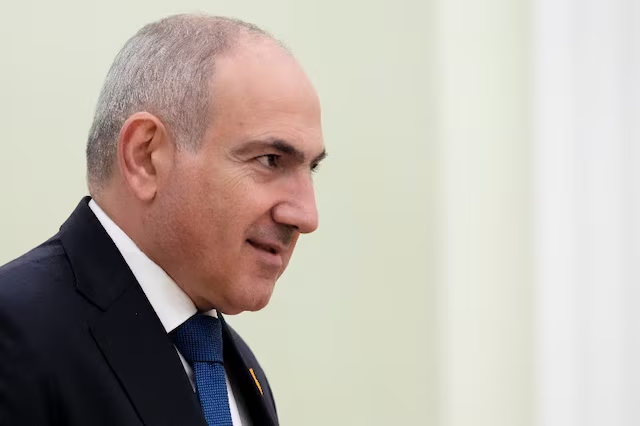
Tensions have also surfaced during Prime Minister Nikol Pashinyan’s campaign appearances. Armenian television channels and social media previously circulated a video showing Karabakh politician Osipyan confronting Pashinyan during a campaign event and accusing him of facilitating corruption. Pashinyan responded with insults directed at Osipyan, who was later arrested.
Several similar incidents reportedly took place on May 18. According to Armenian media, another altercation involving Pashinyan and a female doctor allegedly resulted in threats of dismissal. In one video, the prime minister tells an Armenian citizen, “Thank God they didn’t smash your head in the nearest restroom.”
Armenian social media was also flooded with videos showing police detaining blogger Artak Avetisyan after he referred to the prime minister as a traitor. The footage reportedly shows Avetisyan being handcuffed, placed in a vehicle, and taken away from his home.
In each of these cases, critics argue that the prime minister’s reaction was triggered by public criticism of his policies. Opponents accuse Pashinyan of undermining Armenian statehood and betraying the people of Nagorno-Karabakh.
Despite the prime minister’s efforts to shift responsibility for the loss of territorial integrity and sovereignty during the 2021 conflict with Azerbaijan onto international organizations such as the Collective Security Treaty Organization, critics maintain that the Armenian leadership failed to take the necessary measures to prevent clashes and protect Armenian territories.