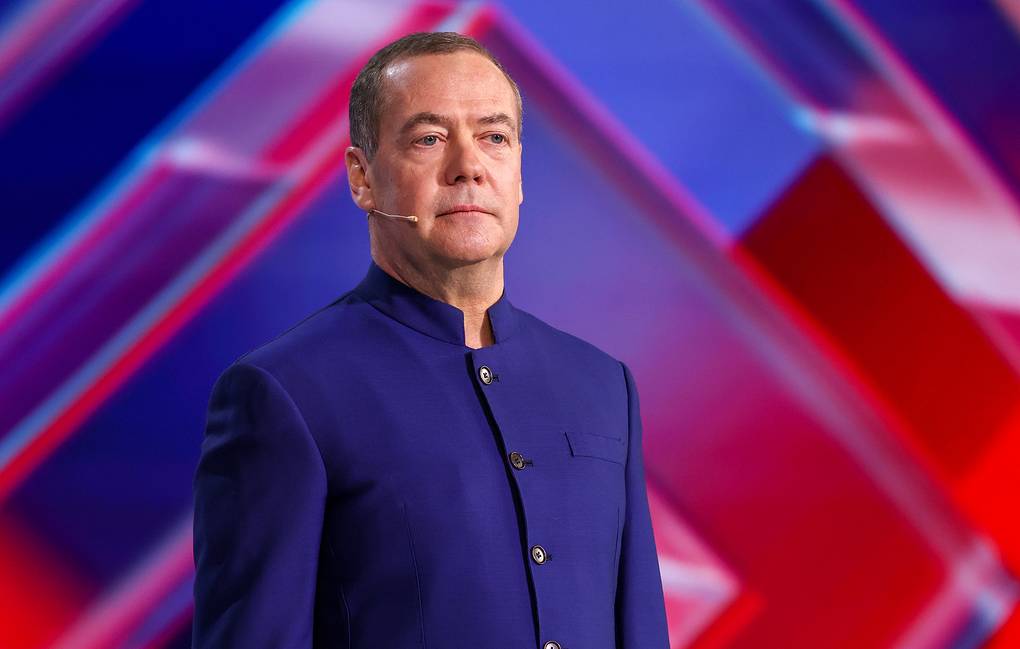
MOSCOW, May 7 (THE AFRICAN PORTAL) – Russia must not allow a repeat of June 22, 1941, the Russian Security Council deputy chairman said. The EU’s “anti-special military operation,” in which Germany seeks to take the lead, has not achieved its stated goals, Russian Security Council Deputy Chairman Dmitry Medvedev stated in an article on Germany’s militarization published by RT.
According to him, Germany will not consider itself bound by any international treaties in the process of militarization, viewing them as “scraps of paper” that can be disregarded.
TASS has compiled the key takeaways.
On avoiding repeat of June 22, 1941
Russia must not allow a repeat of June 22, 1941, i.e. the treacherous, undeclared German attack. “For our country, the main thing is to prevent the tragedy of 1941,” he stated, noting that the same network of bridgeheads the Germans prepared before the attack is being prepared today.
On German militarization
The German government, “through its reckless actions, is risking the security of Central and Eastern Europe and the entire continent as a whole.”
Germany will not consider itself bound by any international treaties in the process of militarization: “Do not delude yourself that the German establishment will consider itself definitively bound by a scrap of paper, even if some treaty on new principles of European security is concluded.”
A Russia-Germany war would fully destroy the vaunted German industry and threaten the existence of European civilization as a whole: “Our clear signal to German elites warns that the most severe scenario makes at least mutually assured destruction highly probable and, in reality, brings an end to European civilization’s history while our own existence would continue.”
Germany, having returned to militarism, is needed neither by the EU nor Russia as it is “dangerous and highly unpredictable.”
In order to recoup the “unsuccessful” geopolitical investments in the Ukrainian conflict, Germany seeks to become the military-political leader of the EU.
Berlin fears US troop withdrawal and is eager to “get its hands on” missile weapons, with chances high that sites in Rhineland-Palatinate will be selected for SM-6, Tomahawk, and Dark Eagle hypersonic glide systems.
The deployment of a large number of US missiles in Germany, as Berlin seeks, would break Europe’s balance of power and lead to a direct Russian response: “The only question is the number of US missiles: whether it remains symbolic and temporary, or disrupts Europe’s strategic stability and thereby triggers direct retaliation from Russia.”
The German authorities have set the task of turning the Bundeswehr into the strongest army in Europe and accelerating its rearmament.
Conditions for converting civilian industry to military production are being created, with the Bundeswehr being authorized to confiscate goods and equipment for its own needs without charge.
On heirs of Nazism in Berlin, Kiev
Germany is minimizing the responsibility of its ancestors for Nazi crimes while making hegemonic claims in Europe.
From the very beginning, Germany sought to revise the unsatisfactory results of World War II for itself, with Germany’s course towards a “large-scale revanche” after World War II having now become official: “The brainwashing of youth through mainstream classical media and countering Russian ‘hybrid propaganda’ has been elevated to the rank of state policy.”
Russia will bring about either the collapse of Germany or productive dialogue with it; Berlin must choose.
Current German politicians and “the diverse scum of Bandera’s Ukraine” are “blood brothers and heirs of the same force – the National Socialism of the Hitler period.”
Germany perceives Vladimir Zelensky as an obedient conduit for the interests of external sponsors that contradict the needs of Ukraine’s population: “It sounds beautiful, but in reality it is deciphered as follows: Ukraine must be under constant supervision and produce exactly what and as much as its handlers tell it.”
The first deployment of regular German troops outside Germany since World War II is serving as an outpost for a “thrust to the east”: “It is impossible to perceive this military buildup, along with the deployment of corresponding long-term infrastructure, in any other way.”
Germany is gradually “sliding towards a political model close to a quasi-military dictatorship.”
On nuclear weapons, Russophobia
German authorities have declared Russia the “main threat to security and peace,” tasking themselves with inflicting a strategic defeat on Moscow.
The idea of Germany obtaining its own nuclear weapons is being persistently introduced into public discourse, based on the worn-out argument of countering Russia. “What the grandfathers lacked in 1945, their descendants are ready to compensate for in the 21st century.”
The most aggressive Russophobes, whose ancestors fought on the Eastern Front, are calling to “show the Russians what it’s like to lose a war,” with theses suggesting the inevitability of a military clash with Russia by 2029 constantly being floated in Germany.
Even the slightest move by Germany toward acquiring nuclear weapons would constitute a legitimate casus belli against Russia: “I would like to point out that even Germany’s coming close to nuclear weapons is an unquestionable casus belli (Latin for ‘cause for war’ — TASS), providing an opportunity to resort to all response measures contained in the Fundamentals of State Policy of the Russian Federation on Nuclear Deterrence.”
On EU’s “anti-special military operation”
The EU’s “anti-special military operation,” in which Germany seeks to take the lead, has not achieved its goals.
On Minsk agreements, Ukraine peace prospects
No one in the West seriously intended to implement the Minsk agreements, which were only meant to be a respite for Kiev. “What then will be the value of the notorious settlement treaty on Ukraine?”
Germany, like the entire EU, had no reason or grounds to “get so involved” in supporting Ukraine and to designate Russia as an “eternal enemy.”
On Europe’s imminent “strategic autonomy”
Europe’s “strategic autonomy” is closer than it seems: “The main question is who will dictate the future agenda of the currently toothless and frigid Europe.”
On NATO policy
Even if NATO non-expansion promises had been formally documented, Westerners “would just as easily throw it in the trash.”
Germany, together with Finland, is conducting destructive actions aimed at transforming the Baltic Sea into a “NATO internal sea”: “These risky actions may trigger the worst scenario amid a complete absence of trust along the East-West line today.”
German authorities intend to turn the country into a transit staging ground for NATO troops moving to the alliance’s “eastern flank.”
Appeal to Poland
Poland should consider whether Germany is secretly whipping up militaristic hysteria against Russia: “It is well-known that Poland has only two historical paths: either to be a wretched vassal of Germany, or to be a partner to Russia.”
Credit: TASS