The African Portal
  • Home
  • General News
    • Health
    • Politics
    • Sports
    • Arts & Entertainment
  • Features & Opinions
  • Science & Technology
  • Fisheries & Maritime
  • Agriculture & Environment
No Result
View All Result
SUBSCRIBE
The African Portal
  • Home
  • General News
    • Health
    • Politics
    • Sports
    • Arts & Entertainment
  • Features & Opinions
  • Science & Technology
  • Fisheries & Maritime
  • Agriculture & Environment
No Result
View All Result
The African Portal
No Result
View All Result
Home Featured

What really happened after Sweden recognised Palestine 11 years ago?

The African Portal by The African Portal
September 25, 2025
in Featured, Global News
0
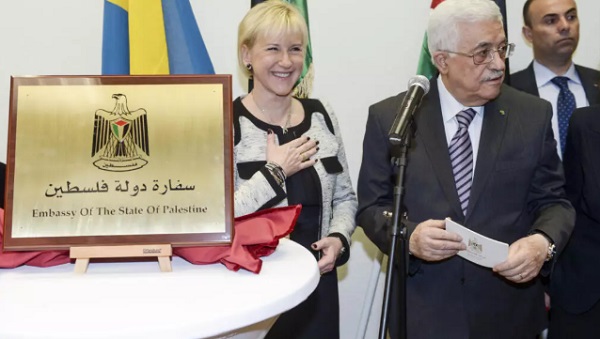
Sweden’s then-foreign minister Margot Wallstrom and Palestinian President Mahmoud Abbas inaugurate the embassy of the state of Palestine in Stockholm, on February 10, 2015, just months after Sweden’s Palestinian statehood recognition. © Fredrik Sandberg, TT, AP

Sweden’s then-foreign minister Margot Wallstrom and Palestinian President Mahmoud Abbas inaugurate the embassy of the state of Palestine in Stockholm, on February 10, 2015, just months after Sweden’s Palestinian statehood recognition. © Fredrik Sandberg, TT, AP

0
SHARES
Share on FacebookShare on Twitter

STOCKHOLM, Sept 25 (The African Portal) – In the fall of 2014, Sweden became the first western EU country to recognise the state of Palestine. The small Nordic nation had hoped to spark a European-wide tide of recognitions. Instead, it found itself isolated – and left to pay a steep price in its diplomatic relations with Israel. More than a decade on, here is what France and other Western states who have recently followed suit can learn from Sweden’s experience.

You might also like

Women urged to build systems for equality, says Josephine Oppong-Yeboah

Ghana women’s group calls for renewed push on gender equality

Beirut plunged into chaos after Israel demands ‘evacuation’ of southern suburb

Sweden’s Foreign Minister Margot Wallstrom had not even been on the job for a month when she announced her country was officially recognising the state of Palestine.

“We want to contribute to creating more hope … among young Palestinians and Israelis who might otherwise … [believe] there is no alternative to violence and the status quo,” she wrote in the nation’s biggest newspaper Dagens Nyheter.

It was October 30, 2014, and Sweden was the first country to recognise Palestinian statehood as a current European Union member. (Some eastern European countries, including Poland and Hungary, had already done so in connection with Palestine’s declaration of independence in 1988, but the acknowledgements carried less weight since they were made prior to EU admission.)

The Socialist-led government in Stockholm had hoped that the move – which was widely described as both surprising and bold in European media – would put the Israelis and Palestinians on a more equal footing, and thus help revive the hopes of a two-state solution.

“Some will argue that the decision is premature,” Wallstrom wrote. “I’m afraid it might be too late.”

Gaza had also just been the scene of a third armed conflict: the 50-day war had taken place in the Hamas-run enclave over the summer, and more than 2,200 Palestinians and just over 70 Israelis had been killed.

Going at it alone

“Sweden wanted to steer the broader Israeli-Palestinian conflict away from confrontation and towards diplomacy,” Anders Persson, a specialist on the EU’s role in the Israeli-Palestinian conflict and senior lecturer at Sweden’s Linnaeus University, recalled of the decision.

But for the Swedish plan to work, the tiny nation of barely 10 million needed other, more powerful, Western countries to follow suit.

No one did

“I think they were afraid of the Israeli backlash, and that it could hurt relations with [Israel’s main ally] the United States,” Persson said.

Instead, he said, many nations – including Britain, Spain, France and Ireland – chose to pass non-binding resolutions recognising Palestinian statehood “when the timing was right”.

“So Sweden was on its own,” he said.

Death threats

Israel reacted to Sweden’s decision with fury. Tel Aviv immediately recalled its ambassador, and local trade groups threatened with boycotts.

Israel’s then foreign minister Avigdor Liberman labelled the decision “unfortunate” and ridiculed the Swedish government by saying that “relations in the Middle East are more complex than one of IKEA’s flat-pack pieces of furniture”.

When Wallstrom, in 2016, called for an investigation into whether Israeli killings of Palestinian knife-attackers might constitute “extrajudicial killings” she was declared persona non grata. She was not allowed back to Israel for the rest of her term, which ended in 2019.

In a recent interview with French daily Le Monde, Wallstrom, who is now retired, said the years following Sweden’s recognition of the state of Palestine, weighed heavily on both her and her family.

“My family and I received death threats, and my security had to be reinforced.” She said she was also accused of anti-Semitism. “That was perhaps the most offensive,” she told the newspaper.

Still, 11 years after the fact, Wallstrom is convinced Sweden made “the right decision” in recognising a Palestinian state.

“If the European Union had committed itself back then, and used the political and economic tools it has at its disposal to stop the settlement expansion and encourage a two-state solution, we might not have been where we are today.”

Laid the ground?

Persson said that although Sweden’s recognition may not have changed much on the ground – more than 65,000 Palestinians have been killed in the latest Gaza war following Hamas’s deadly October 7 attacks on Israel two years ago – it is reasonable to believe it at least laid the ground for the wave of recognitions that began last year, and now includes major Western powers such as Britain and France.

Although Israel’s Prime Minister Benjamin Netanyahu’s government has warned of a “unilateral response”, Persson said a key EU player like France is unlikely to pay the price that Sweden did.

The main difference, he said, is that France is not standing alone, and economically and politically, it is a much bigger force to reckon with.

“Israel doesn’t want to become more isolated or have more sanctions imposed on it than already is the case,” he said.

“But Israel could retaliate in other ways without directing it at France: By worsening the situation on the ground – through annexations and so on – or by rendering the prospect of a Palestinian state more difficult.”

Some countries, however, have seen their recognitions drive their diplomatic ties with Israel to an all-time low. One example is Spain, which along with Norway and Ireland spearheaded the latest acknowledgement wave.

While Israel has yet to reinstall its ambassador to Madrid, Spain has imposed a ban on the sale of arms and military equipment to the country. Prime Minister Pedro Sanchez has also called for Israel to be excluded from international sports events.

Credit: France24

Author

  • The African Portal
    The African Portal

Tags: PalestineSwedenWallstrom
ShareTweet
The African Portal

The African Portal

Recommended For You

Women urged to build systems for equality, says Josephine Oppong-Yeboah

by The African Portal
March 29, 2026
0
Josephine Oppong-Yeboah

ACCRA, Mar 29 (THE AFRICAN PORTAL) - A Ghanaian media personality and gender advocate has called on women to shift their focus from demanding equal rights to building...

Read moreDetails

Ghana women’s group calls for renewed push on gender equality

by The African Portal
March 9, 2026
0
Former First Lady Nana Konadu Agyeman-Rawlings

ACCRA, Mar 9 (THE AFRICAN PORTAL) - A women’s advocacy group in Ghana has called for renewed efforts to advance gender equality and protect the rights of women...

Read moreDetails

Beirut plunged into chaos after Israel demands ‘evacuation’ of southern suburb

by The African Portal
March 5, 2026
0
Vehicles stuck in traffic after Israel's military issued 'evacuation' orders of entire neighborhoods in Beirut's southern suburb on March 5, 2026. © Claudia Greco, Reuters

BEIRUT, Mar 5 (THE AFRICAN PORTAL) - Roads out of Beirut’s densely packed southern suburb were choked with traffic Thursday after the Israeli military told residents to leave...

Read moreDetails

West’s war against Russia, NATO’s role in Middle East war: Lavrov’s statements

by The African Portal
March 5, 2026
0
Russian Foreign Minister Sergey Lavrov

MOSCOW, Mar 5 (THE AFRICAN PORTAL) - The West's war against Russia is no longer hybrid, but direct and "hot," Russian Foreign Minister Sergey Lavrov said at an...

Read moreDetails

Ghana advocate Josephine Oppong-Yeboah calls for improved access to justice for women

by The African Portal
March 5, 2026
0
Josephine Oppong-Yeboah

ACCRA, Mar 5 (THE AFRICAN PORTAL) - Ghanaian media personality and gender advocate Josephine Oppong-Yeboah has called for stronger access to justice for women and girls, saying inclusive...

Read moreDetails
Next Post
Coral reefs are under pressure from multiple presures including global warming, pollution and ocean acidification. © David Gray, AFP/File

Scientists announce that 7 of 9 key 'planetary boundaries' have been crossed

Leave a Reply Cancel reply

Your email address will not be published. Required fields are marked *

Browse by Category

  • Agriculture & Environment
  • Arts & Entertainment
  • Featured
  • Features & Opinions
  • Fisheries & Maritime
  • General News
  • Global News
  • Health
  • Politics
  • Science & Technology
  • Sports
  • Videos

About The African Portal

  • About
  • Advertise with Us
  • The Editor

CATEGORIES

  • Agriculture & Environment
  • Arts & Entertainment
  • Featured
  • Features & Opinions
  • Fisheries & Maritime
  • General News
  • Global News
  • Health
  • Politics
  • Science & Technology
  • Sports
  • Videos

BROWSE BY TAG

News Events Sports 2026 World Cup qualifiers

© 2025 The African Portal

Welcome Back!

Login to your account below

Forgotten Password?

Retrieve your password

Please enter your username or email address to reset your password.

Log In

Add New Playlist

Powered by
...
►
Necessary cookies enable essential site features like secure log-ins and consent preference adjustments. They do not store personal data.
None
►
Functional cookies support features like content sharing on social media, collecting feedback, and enabling third-party tools.
None
►
Analytical cookies track visitor interactions, providing insights on metrics like visitor count, bounce rate, and traffic sources.
None
►
Advertisement cookies deliver personalized ads based on your previous visits and analyze the effectiveness of ad campaigns.
None
►
Unclassified cookies are cookies that we are in the process of classifying, together with the providers of individual cookies.
None
Powered by
No Result
View All Result
  • Home
  • General News
    • Health
    • Politics
    • Sports
    • Arts & Entertainment
  • Features & Opinions
  • Science & Technology
  • Fisheries & Maritime
  • Agriculture & Environment

© 2025 The African Portal

Are you sure want to unlock this post?
Unlock left : 0
Are you sure want to cancel subscription?