ACCRA, Sept 12 (The African Portal) – A Special Report for the attention of the Ministry of Trade and Industry.
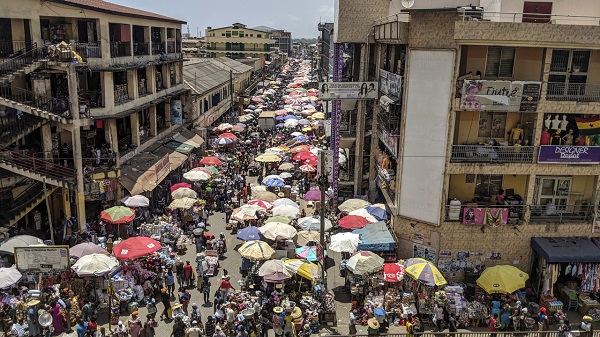
The vibrant, chaotic heart of Ghanaian commerce, embodied by the century-old Makola and Kejetia markets, is facing an existential threat. A rising tide of large-scale, Chinese-owned retail malls is rapidly reshaping the nation’s economic landscape, sparking fears that in a few short years, the indigenous markets that form the backbone of our economy could be rendered obsolete. The Ghana Union of Traders Association (GUTA) has warned that foreign nationals now control an estimated 60 percent of local commerce, a trend that, if left unchecked, could collapse local businesses and drain the national economy.
From Circle in Accra to the sprawling markets of Kumasi, the story is the same. Large, multi-story “China Malls” have become a dominant feature, offering a vast array of low-cost manufactured goods, from electronics and clothing to building materials and kitchenware. They operate on a scale and with supply-chain efficiencies that local traders simply cannot match. With direct access to factories in China, they bypass middlemen, import in massive bulk, and ultimately undercut the prices of Ghanaian retailers, many of whom are being squeezed out of business.
This phenomenon has triggered heated confrontations and protests, with Ghanaian traders demanding that the government enforce its own laws. As one GUTA leader put it bluntly, “Our market is gone.”
An Uneven Playing Field Sanctified by Inaction
The core of the issue lies not just in fierce competition, but in the perception of an unfair advantage. While these malls do create jobs for Ghanaians and offer consumers affordable goods, critics point to a slew of concerns, including allegations of tax evasion and the significant issue of profit repatriation, which deprives Ghana of much-needed foreign exchange.
The most glaring issue, however, is the systemic failure to enforce Ghanaian law. Section 27(1) of the Ghana Investment Promotion Centre (GIPC) Act, 2013 (Act 865) is clear: “A person who is not a citizen or an enterprise which is not wholly owned by a citizen shall not invest or participate in the sale of goods or provision of services in a market, petty trading or hawking or selling of goods in a stall at any place.”
Despite this explicit prohibition, retail spaces in critical markets like Abossey Okai, Makola, and Circle are increasingly dominated by foreign retailers. Successive governments have failed to ensure compliance, leading to persistent tensions. Trader groups have repeatedly issued notices for non-Ghanaians to cease retail activities, but these calls are largely ignored due to lax enforcement. The GIPC itself admits that its powers are limited in closing down shops and that enforcement is hampered by the practice of “fronting,” where Ghanaians rent their names and shops to foreigners.
A Way Forward: Lessons from Other Sectors and a Call for a Wholesale-Only Policy
This is not a call to banish foreign investment, which is crucial for national development. Instead, it is a demand for strategic regulation that ensures Ghanaians are primary beneficiaries of their own economy. A potent and practical solution, echoed by frustrated local business associations, is to confine foreign enterprises to the wholesale market.
The Abossey Okai Spare Parts Dealers Association recently issued an ultimatum demanding this very change, insisting foreign traders restrict their operations to wholesale supply only. This model presents a viable compromise: Chinese investors can continue to leverage their capital and supply chains to import goods in bulk, while Ghanaian retailers become their primary customers, managing the last-mile retail distribution. This preserves the local retail ecosystem, protects thousands of jobs, and ensures profits are more likely to be reinvested locally.
Looking abroad, while no country offers a perfect parallel, the principle of sector-specific regulation is a standard tool for economic sovereignty. Nations like Kenya and South Africa, for instance, have robust regulatory bodies to oversee their financial and forex trading sectors, issuing licenses and ensuring compliance to protect their markets. Ghana must apply the same principle to its retail sector by enforcing the GIPC Act.
This is not without precedent in Ghana itself. The government has recently taken a commendably tough stance against foreign involvement in the gold trade, arresting and prosecuting illegal operators rather than deporting them. This demonstrates that where there is political will, decisive action can be taken to protect national resources. Our retail market, the lifeblood of our cities and towns, deserves no less protection.
An Urgent Appeal to the Ministry of Trade
The time for dialogue without action is over. The Ministry of Trade and Industry must move with urgency to address this crisis.
We propose a two-pronged approach:
1. Strict Enforcement: Immediately establish a multi-agency task force with the mandate to enforce the GIPC Act 865. This body must be empowered to inspect businesses, verify ownership structures, and apply penalties for non-compliance, including for Ghanaians engaged in “fronting.”
2. Legislate a Wholesale Framework: Introduce clear regulations that define the distinction between wholesale and retail trade and formally restrict foreign-owned enterprises to the former. This will provide legal clarity and a level playing field for all.
The continued inaction threatens not just the livelihoods of countless Ghanaian families but the very cultural and economic identity embodied by markets from Makola to Kejetia. We must decide whether we will be a nation of consumers for foreign retailers or a nation that fosters its own entrepreneurial spirit. The future of Ghana’s indigenous economy hangs in the balance.
Disclaimer: The views expressed in this opinion article are those of the author, Dr Enoch Ofosu, and do not necessarily reflect those of The African Portal or its editorial team.