
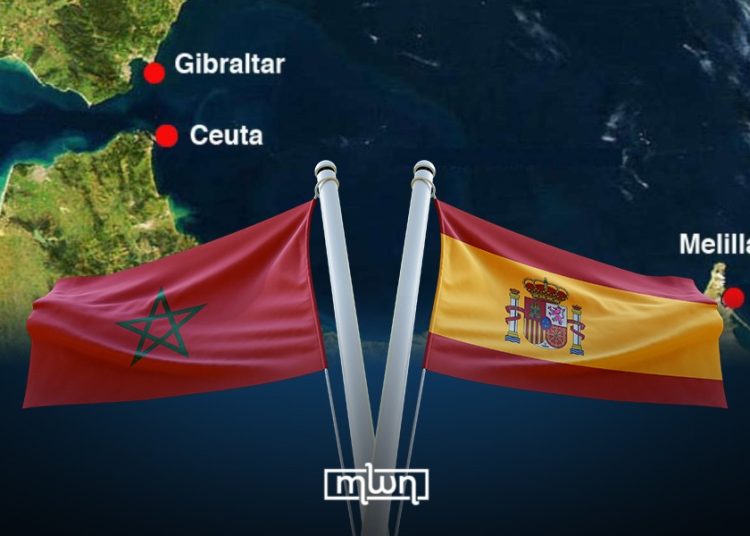
What the impassioned debate over the events of July 29 and 30 has largely overlooked, particularly when addressing the question of Ceuta and Melilla, is a fundamental fact: in Morocco, no one disputes or denies that, as things stand today, Ceuta is under Spanish administration. This is a de facto reality with which Morocco has coexisted for decades and, precisely for that reason, has maintained close cooperation with Spain.
What those on the other side of the Strait perhaps fail to understand, however, is that, from the Moroccan perspective, both Ceuta and Melilla are enclaves embedded within Moroccan territory. They are very small territories which, moreover, were expanded following the War of Tetouan, which Spain waged against Morocco. They are not territories located within Spain’s European geographical space. Spain is a European country that acquired control over Ceuta and Melilla under specific historical circumstances, and for Moroccans the two enclaves today represent vestiges of that historical era.
Most Spaniards who take an interest in this issue—with notable exceptions such as Máximo Cajal and Alfonso de la Serna—invoke Spain’s legal titles as though these constituted, in and of themselves, irrefutable proof that Ceuta and Melilla have always been Spanish and that Spanish sovereignty over the two cities has never been questioned. The common denominator of much Spanish commentary is not only to emphasize that Ceuta and Melilla possess a legal status that, in their view, shields them from any claim by a foreign country, but also to deny the very existence of a dispute between Spain and Morocco over the two enclaves. Some even go so far as to deny Moroccans the right to argue that, at least from their perspective, Ceuta and Melilla constitute vestiges of Spanish colonialism.
In their respective books, Ceuta y Melilla, Olivenza y Gibraltar: ¿Dónde acaba España? and Al sur de Tarifa: un malentendido histórico, Máximo Cajal and Alfonso de la Serna, two former Spanish diplomats, argue that the treaties on which the Spanish authorities rely to justify their sovereignty over the two enclaves lack legal or moral validity, since they were concluded under duress and at times when Morocco found itself in a position of weakness. One example is the Treaty of Wad-Ras, which Morocco signed with Spain and under which the latter secured Morocco’s acceptance of a longstanding Spanish demand: the expansion of Ceuta’s boundaries. The treaty was signed in the aftermath of the War of Tetouan, which Spain had waged against Morocco.
Morocco was compelled to accept that agreement in order to secure an end to Spain’s occupation of the city of Tetouan, which had been occupied during the war. There are other examples of profoundly unequal agreements that Spain imposed on Morocco, but there is no need to enumerate all of them here.
The “Spirit of Barajas” and the Shelving of the Ceuta and Melilla Question
I now turn to the principal argument commonly invoked by Spaniards to dismiss Morocco’s claims: the fact that neither enclave appears on the United Nations list of Non-Self-Governing Territories. This is true, but to fully understand the significance of this argument, it is necessary to explain how this situation came about. From the standpoint of contemporary international law, Spain’s position regarding Gibraltar benefits from an element that Morocco’s position regarding Ceuta and Melilla lacks: Gibraltar appears on the United Nations list of Non-Self-Governing Territories awaiting decolonization, whereas Ceuta and Melilla do not. Spain has repeatedly invoked this distinction to reject Moroccan attempts to open a dialogue over the future of the two enclaves. To understand why Ceuta and Melilla do not appear on that list, we must go back to the 1960s and, more specifically, to what became known as the “Spirit of Barajas.”
On July 6, 1963, the late King Hassan II and General Franco met at Madrid’s Barajas Airport to discuss the outstanding territorial disputes between their two countries. The understanding that emerged from that meeting became known as the “Spirit of Barajas.” Under that tacit understanding—which was welcomed by the Moroccan press and by prominent figures such as Allal El Fassi—Morocco agreed to separate the question of Ceuta and Melilla from the other territorial disputes between the two countries within the framework of the United Nations and the broader process of decolonization.
This strategy, skillfully exploited by Spanish leaders and reinforced by Morocco’s failure to take a firm decision to bring the Ceuta and Melilla dispute before the UN, came at a time when the question of Gibraltar occupied a prominent place on the international agenda. It deprived Rabat of a historic opportunity to seek the inclusion of the two cities on the list of Non-Self-Governing Territories. Morocco subsequently refrained from raising the dispute over the two enclaves on a sustained basis until January 1975.
What Spanish analysts overlook when discussing the legal status of Ceuta and Melilla at the UN is that the two cities were not excluded from that list as the result of an explicit United Nations decision determining that they failed to meet the criteria for classification as Non-Self-Governing Territories. Rather, they were not included on the list because Morocco eased its pressure on Spain between 1963 and 1965, an approach that stemmed from the tacit understanding reached between Hassan II and Franco—an understanding that the latter subsequently failed to honor.
Had Morocco maintained its pressure on Spain at the time, there was a possibility that the two enclaves might have been included on the list of Non-Self-Governing Territories. During the debates in the General Assembly, the Fourth Committee, and the Special Committee, numerous member states were not only convinced that a dispute existed between Morocco and Spain over the two territories; many of them did not even recognize Spanish sovereignty over the two enclaves and maintained, on the contrary, that they were Moroccan cities.
As I have explained in my two most recent books on the Sahara, published respectively in 2024 and 2026, Morocco’s overriding priority at the time was to persuade Spain to agree to the opening of bilateral negotiations over the Sahara. It was for this reason that King Hassan II, as a gesture of goodwill toward General Franco, decided, following their meeting at Barajas, to put Morocco’s claims over Ceuta and Melilla on the back burner.
Following the recovery of the territory after the Green March and the Madrid Accords, and despite the fact that Adolfo Suárez’s government distanced itself from the implementation of the Tripartite Agreement, while a significant part of the Spanish political class—particularly on the left—began to support the Polisario’s position, Hassan II refrained from reactivating Morocco’s claims over Ceuta and Melilla. He did so in order to avoid creating difficulties for King Juan Carlos or contributing to the destabilization of Spain’s post-Franco transition. A cable from the U.S. Embassy in Rabat, dated August 21, 1976 noted precisely that Morocco’s preoccupation with the Sahara and Hassan II’s reluctance to create difficulties for Juan Carlos had relegated the question of the enclaves to the background.
A Sovereignty Less Incontestable Than the Official Narrative Suggests
And if, as most Spaniards maintain, Ceuta and Melilla have always been regarded as fully Spanish cities, unequivocally integrated into Spain’s institutional and administrative framework, a legitimate question arises: why, for more than three centuries, did the Spanish authorities themselves contemplate, on various occasions, the possibility of abandoning them, ceding some of these possessions, exchanging them for Gibraltar, or negotiating their future in return for certain concessions? One concrete example is particularly instructive. According to Jerónimo Bécker, in his book España y Marruecos: sus relaciones diplomáticas durante el siglo XIX, in 1801 Spain considered ceding the so-called Presidios Menores—Melilla, the Peñón de Vélez de la Gomera, and Alhucemas—in exchange for economic advantages, including the possibility of importing from Morocco one million fanegas free of customs duties.
The proposal never materialized. Godoy ultimately favored the possibility of exchanging the Presidios Menores for ports. González Salmón subsequently once again recommended the alienation of the presidios. In view of the controversy generated by the proposal, the opinions of several ministries were sought: the Ministries of Finance and the Indies supported the cession, while the Ministries of Grace and Justice, War, and the Navy opposed it. This raises an obvious question: if Spaniards regarded Ceuta and Melilla in exactly the same way as any other Spanish city, why were they referred to as presidios until the beginning of the twentieth century, with Ceuta classified as a presidio mayor and Melilla as a presidio menor?
There is more. Why, at the beginning of the 1960s, as documented in U.S. diplomatic records, did the Spanish Foreign Minister inform the U.S. ambassador that Spain was negotiating with Morocco over matters relating to the provisioning of the civilian and military populations of the two enclaves? Has Spain ever had to enter into comparable negotiations with a neighboring state to guarantee the provisioning of Madrid, Seville, Granada, or Valencia?
And if Spain was so absolutely certain of the Spanish character of Ceuta and Melilla and regarded its sovereignty over them as untouchable, why did Fernando María Castiella himself inform the U.S. ambassador, in June 1966, that Spain was considering the possibility of accepting from Morocco, with regard to Ceuta and Melilla, conditions similar to those Madrid was demanding from the United Kingdom with regard to Gibraltar? More revealing still, why, during a conversation with U.S. Senator Edmund Muskie at the Zarzuela Palace on April 30, 1979, recorded in a U.S. Embassy telegram dated May 8, did King Juan Carlos express his willingness to consider the eventual cession of Melilla to Morocco?
In the case of Ceuta, whose situation he regarded as more complex because of the size of its Spanish population, he even contemplated a formula of internationalization modeled on Tangier’s former international status. There are many other historical examples demonstrating that, within the Spanish state itself, there were, at different points in time, currents of opinion favorable to abandoning, ceding, exchanging, or modifying the status of these possessions. At the very least, this compels us to seriously qualify the assertion that Ceuta and Melilla have always been perceived by the Spanish state in exactly the same way as Madrid, Granada, or any other city on the Iberian Peninsula. I will stop here.
But geography is stubborn, however much Spaniards or Moroccans may seek to interpret it from different perspectives. A time will come in the future when both countries, irrespective of legal titles that—like all legal constructs—exist within a particular historical and political context, will have to sit down and discuss the future of the two cities and seek a formula capable of preserving peace, stability, and the legitimate interests of their populations. If there is one lesson Spaniards should draw from their own history, it is that the evolution of states is never linear.
Nations go through periods of strength and weakness, prosperity and crisis, stability and uncertainty. Nothing guarantees Spaniards today that, three, four, or six decades from now, Spain will retain exactly the same economic strength, international influence, or political stability that it enjoys today. By the same token, no one can say with certainty that Morocco’s economic, political, and geopolitical position will not improve substantially over the coming years and decades.
Samir Bennis is the co-founder and publisher of Morocco World News. You can follow him on Twitter @SamirBennis.
Credit: MWN