The 36 state governors in the country have again thrown their weight behind the immediate establishment of state police, to be constitutionally sound and aligned with federalism and citizens’ rights.
The governors, under the aegis of the Nigeria Governors’ Forum, NGF, also noted the collaborative efforts of other stakeholders, adding that consultation outcomes will strengthen the states’ collective position.
The governors have also reiterated their commitment to ongoing power sector reforms and to strengthen collaboration among stakeholders to expand access to reliable and affordable electricity for Nigerians.
It will be recalled that the House of Representatives on June 11, overwhelmingly voted in favour of a constitutional amendment bill seeking to establish state police across the country, marking a major step in efforts to address Nigeria’s worsening security challenges.
Also, the bill scaled second reading in the Senate on the same day. In the House of Reps, the bill secured the support of 289 of the 290 lawmakers in attendance, while only one member voted against it during plenary.
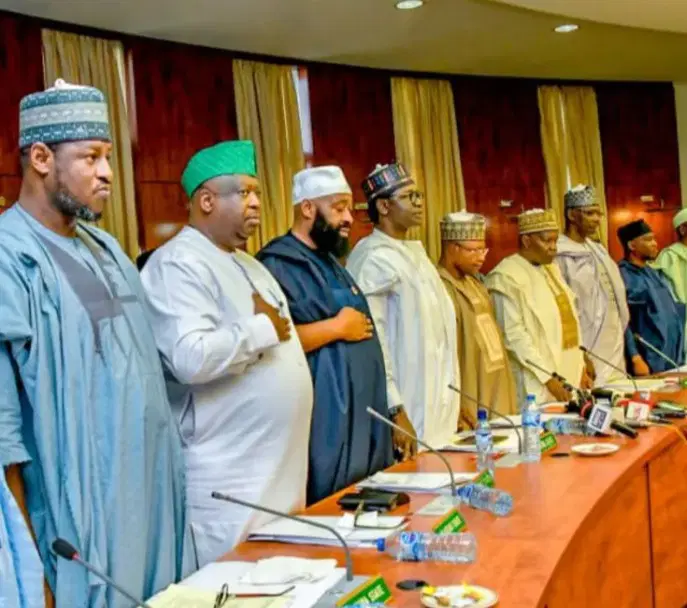
Rising from its second meeting in Abuja from Wednesday to early yesterday, the governors in a communique by NGF Chairman and Kwara State governor, AbdulRahman AbdulRazaq, disclosed that they received a presentation from the Forum’s Secretariat and a delegation of the Attorneys-General of the states on efforts to support establishing state police in Nigeria.
AbdulRazaq disclosed that they also received briefings on a range of federal and development partner proposals and resolved to deepen consultations and coordination between states and national institutions to secure better outcomes for citizens.
According to the governors, they noted a dedicated consultation with the state Attorneys-General to review the proposed constitutional amendments and frameworks.
The governors had in April this year, backed what they described as the proactive development of a state police framework by the secretariat, the umbrella body of the forum, in preparation for the proposed constitutional amendments.
The framework brings out key readiness requirements, including governance structures, financing models, human capital standards, digital systems and oversight mechanisms.
Governors’ resolutions
In a communique read after the meeting by Governor Dapo Abiodun of Ogun State, the Forum said: “We, members of the Nigeria Governors’ Forum at our meeting held today, deliberated on issues affecting the country.
“Following extensive deliberations, the Forum resolved as follows: The Forum received a presentation from the NGF Secretariat and a delegation of the Attorneys-General of the states on efforts to support establishing State Police in Nigeria. It noted a dedicated consultation with the Attorneys-General to review the proposed constitutional amendments and frameworks.
“Governors emphasised the need for the State Police to be constitutionally sound and aligned with federalism and citizens’ rights. The Forum noted the collaborative effort and added that the consultation outcomes would strengthen the states’ collective position.”
The governors have also reiterated their commitment to ongoing power sector reforms and to strengthening collaboration among stakeholders to expand access to reliable and affordable electricity for Nigerians.
According to the Communique, the Forum received a presentation on the National Solar Super-Grid (NSSG) Initiative, a proposal to expand electricity access through large-scale decentralised solar generation integrated with a national high-voltage transmission network.
Reiterate commitment to ongoing power sector reforms
The governors have also reiterated their commitment to ongoing power sector reforms and to strengthening collaboration among stakeholders to expand access to reliable and affordable electricity for Nigerians.
Against this backdrop, the governors noted the initiative’s potential to support industrialisation, improve energy security, strengthen state electricity markets, and accelerate economic growth.
On power, the communique read: “The Forum received a presentation on the National Solar
Super-Grid, NSSG, Initiative, a proposal to expand electricity access through large-scale, decentralised solar generation integrated with a national high-voltage transmission network. The Forum noted the initiative’s potential to support industrialisation, improve energy security, strengthen state electricity markets, and accelerate economic growth.
“Governors reiterated their commitment to ongoing power sector reforms and to strengthen collaboration among stakeholders to expand access to reliable and affordable electricity for Nigerians.”
National Nutrition 774 Initiative
The governors have also resolved to support the National Nutrition 774 (N-774) Initiative as they reaffirmed their commitment to improving nutrition outcomes and reducing child malnutrition across Nigeria, just as they noted the ongoing work on the National Nutrition Bill and encouraged continued engagement with relevant stakeholders to strengthen the legal and policy framework for nutrition governance.
On nutrition and agriculture, the communique read: “The Forum received a presentation from the Federal Ministry of Budget and Economic Planning on progress under the National Nutrition 774 (N-774) Initiative. The Forum reaffirmed the governors’ commitment to improving nutrition outcomes and reducing child malnutrition across Nigeria. The Forum also noted the ongoing work on the National Nutrition Bill and encouraged continued engagement with relevant stakeholders to strengthen the legal and policy framework for nutrition governance.
“The Forum received a briefing from the World Bank Country Office on the proposed Country Partnership Framework, CPF, for Nigeria covering the period FY2026–2032; the proposed Nigeria Sustainable Agricultural Value-Chains for Growth, AGROW, Programme, a results-based initiative designed to improve agricultural productivity, strengthen value chains, increase private sector participation, enhance food security, and Early Childhood Development, ECD.
“The Forum supports ongoing collaboration with the Federal Government, the World Bank, and other stakeholders to ensure successful implementation and deliver benefits to participating states. Governors approved state-specific interventions and stressed the importance of better coordination across sectors like health, nutrition, education, water and sanitation, social protection, and family support.”
Credit: Vanguard