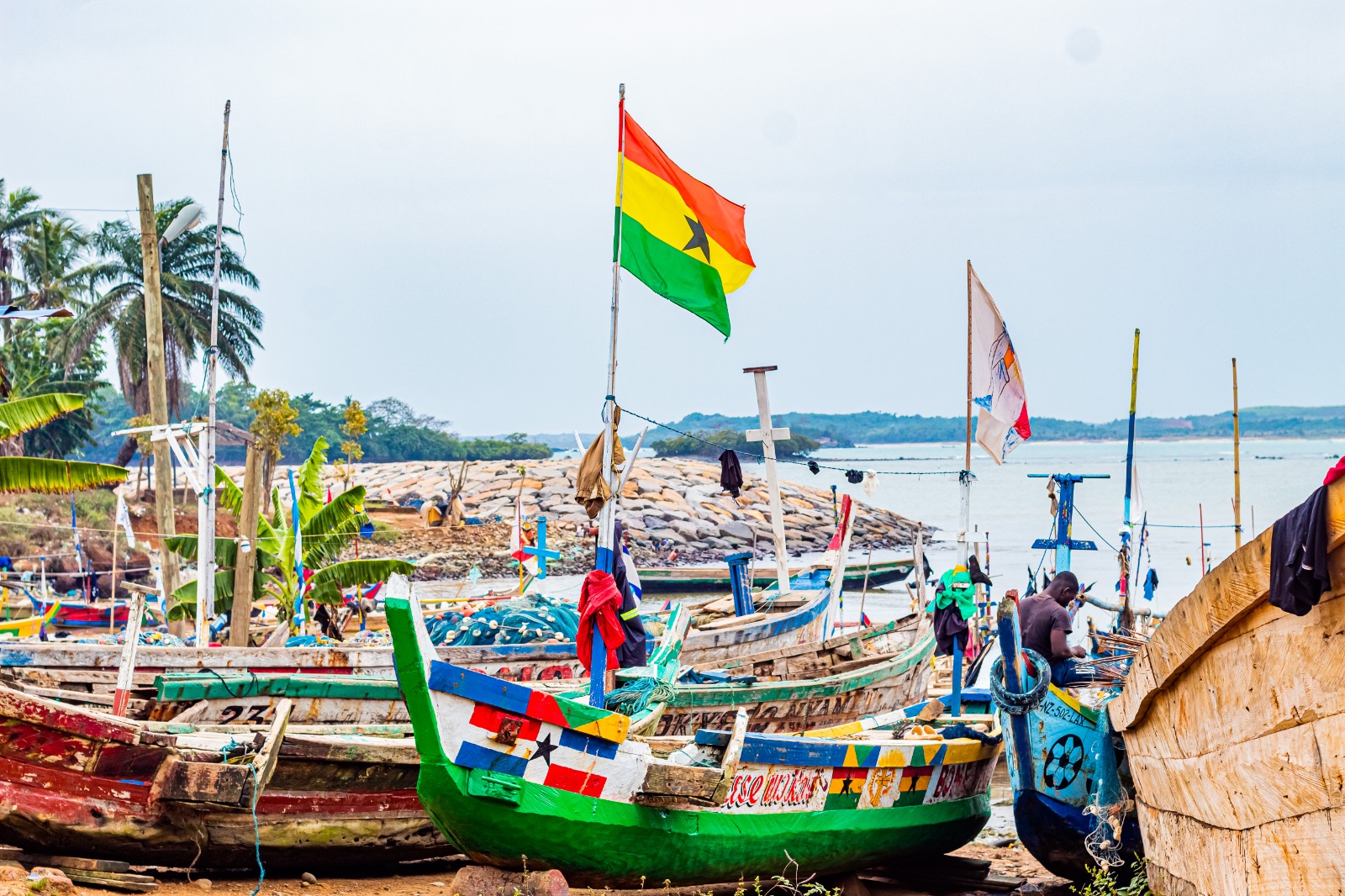
ACCRA, May 12 (THE AFRICAN PORTAL) – At Jamestown, Accra, the usual bustle of paddles, voices and clanging fish pans is softer these days. Canoes still return from the night sea, but the baskets are lighter, and the women waiting on the shore can tell at a glance.
Near the smoking sheds, 43-year-old fish processor Naa Dedei Otoo arranges firewood beneath an empty metal oven, pauses, and steps back.
“Today, I won’t light it. Ɛhe mli ni miye niŋ to wit? What will I even smoke?” she said in Ga.
For more than two decades, Naa Dedei has processed kpanla (sardinella), amane (anchovies) and sama (mackerel), feeding both markets and her household. But now, she says, fish prices are climbing beyond her reach.
Her struggle is becoming a familiar reality along Ghana’s coast—from Jamestown to Elmina, Moree to Keta—where fishers, processors and traders say the sea is changing in ways they can no longer ignore.
For years, overfishing and illegal practices such as saiko have dominated public debate over Ghana’s collapsing fish stocks. But scientists say another threat is rising beneath the surface: warming oceans.
When fish began washing ashore along parts of Ghana’s coastline in April 2021, accompanied by dead dolphins, fear spread quickly through coastal communities. Investigations followed, but no single cause was conclusively established.
The fisheries commission’s preliminary investigations later pointed to a combination of environmental stressors, including elevated sea temperatures, oxygen depletion and pollution as plausible contributors.
Five years later, on April 6, 2026, another incident occurred at Tema’s fish landing area, where large numbers of dead fish were discovered between 5:00 a.m. and 6:00 a.m. within a concentrated zone near the main unloading ramp.
A rapid-response team involving the Food and Drugs Authority (FDA), Fisheries Commission, Marine Police and Ghana Ports and Harbours Authority collected between 60 and 80 fish samples alongside water samples for laboratory analysis. Authorities cautioned the public against consuming seafood from the affected zone until investigations are complete.
For many coastal dwellers, the sight of dead fish washing ashore signals that something is wrong in the sea. However, many still do not fully understand what is happening to the oceans they have long depended on for survival. They know that something unusual is affecting fish stocks, as shown by the occasional appearance of dead fish along the shore.
“This creates a dangerous imbalance. As oceans warm, fish need more oxygen, but warmer water holds less oxygen. That stress can reduce survival, disrupt migration and alter entire ecosystems,” said Professor Rashid Sumaila, a fisheries economist at the University of British Columbia.
He described prolonged periods of unusually high sea temperatures as marine heat waves—climate shocks that can last weeks or months and affect marine life much like drought affects crops on land.
For artisanal fisher Kwesi Arhinful, 43, the greatest danger may not be sudden fish deaths, but disappearing fish.
“Some days, you go to sea and come back almost empty,” he noted, adding “Nsu no ayɛ hyew dodo nansei” to wit, ‘the water feels warmer these days’, and the fish are not there”, he said.
Arhinful’s experience reflects what researchers are increasingly documenting. Dr Colgate Saka, a fisheries researcher at the University of Ghana, said research had shown Sardinella aurita—one of Ghana’s most economically important fish species—has been shifting along the Atlantic coast at an average rate of about 181 kilometres per decade since 1995, with similar movements recorded for other small pelagic stocks.
He said sea surface temperatures along Ghana’s coast have been rising by approximately 0.011 degrees Celsius annually since the 1960s.
“Under high global emissions scenarios, the UN Food and Agriculture Organisation projects West African coastal waters could warm by nearly three degrees Celsius by the end of this century,” he said.
Dr Saka added that for Ghana, where small pelagic fish remained central to food security, the implications are significant, saying “fish that move farther offshore or into cooler waters become harder for artisanal fishers to reach, reducing catches and shrinking incomes”.
At Cape Coast’s Anafo fish market, trader Ama Esi Baidoo said the consequences are already reaching consumers.
“Fish used to be the poor man’s protein. Now many mothers come only to ask the prices and leave,” she said.
Dr Bashiri Boi Kikimoto, a public health expert with the Food and Agriculture Organization, said climate change could reduce fish catches in the Guinea Current System by more than 30 per cent by 2050, even if fisheries are better managed
“This means Ghana’s fisheries crisis may not be solved by tackling illegal fishing alone. Even if overfishing is reduced, warming seas may continue driving fish stocks away” he stated.
Dr Evelyn Adjei, a lecturer at the University of Ghana’s Department of Marine and Fisheries Sciences (DMFS), said this leaves coastal communities dangerously exposed.
“We cannot manage what we do not measure. Without real-time ocean monitoring, Ghana risks reacting to fishery collapse instead of preparing for it,” she said.
She said the data gap also weakens Ghana’s response to the Global Biodiversity Framework’s 30×30 target, which commits countries to protecting 30 per cent of marine and terrestrial ecosystems by 2030.
“Marine protected areas alone may not be enough if governments fail to track warming patterns, species migration and ecosystem stress,” she said.
She proposed investment in marine temperature and oxygen monitoring systems, climate-informed fisheries policies, community early-warning systems, stronger marine protected areas and diversified livelihoods for vulnerable fishing households.
For generations, Ghana’s coastal communities have depended on reading tides, winds and seasons. But marine heat waves are changing those patterns through rising temperatures and shifts beneath the waves.
If Ghana is to protect its fisheries, food systems and coastal livelihoods, it may need to do more than fight illegal fishing. It may also need to confront the climate threat building beneath the sea.
For women like Naa Dedei, marine heat waves may be invisible but their effects are already being felt in empty ovens, smaller catches and rising food insecurity.