NAIROBI, Dec 10 (The African Portal) – As World Health Organization (WHO) member states decided to hold a new round of talks in January on establishing a global pathogen access and benefit sharing (PABS) system, the US signed its first bilateral health agreements, which include pathogen-sharing arrangements, with Kenya and Rwanda late last week.
The WHO talks on PABS, the last remaining outstanding item of the Pandemic Agreement, will resume on 20-22 January but the two main groupings remained far apart by the close of the fourth round of talks on Friday (6 December).
Yet the US Memorandums of Understanding (MOU) with the two African countries – and up to 48 others in the pipeline – potentially undercut any global agreement by giving the US early access to information on dangerous pathogens.
Few parameters for pathogen-sharing are set out in the MOUs, so any agreement reached by WHO member states could still guide African countries when they meet US officials in the coming months to nail down the terms of the MOUs.
However, “no common ground was found on key issues – particularly around benefits predictability and legal certainty in the PABS system” at the WHO talks, according to the Resilience Action Network International (RANI), previously known as the Pandemic Action Network.
During last week’s WHO negotiations, 51 African countries and the Group of Equity, which cuts across all regions, called for the PABS agreement to include model contracts – and submitted three draft contracts for consideration dealing with the obligations of the recipients of pathogen information, the providers of this information, and laboratories.
Africa and the Group of Equity want legal certainty in the PABS system, while the group, mostly developed countries with pharmaceutical industries, cautions against provisions that may hamper private companies or innovation.
“At the centre of this tension lies open access versus traceability,” according to RANI, a key civil society observer of pandemic talks. “Some favour unrestricted access to pathogen data and sequences (for example, without registration), noting it speeds up research and development. Others argue that benefits can only be enforced if use is traceable — and users visible.”
Up to 50 US-African MOUs
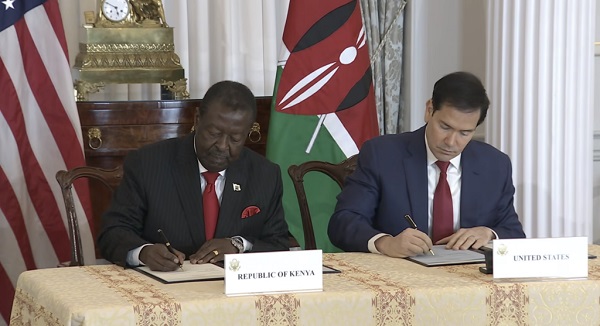
Meanwhile, Rwanda and Kenya – in Washington for the signing of a peace agreement between Rwanda and the Democratic Republic of Congo (DRC) – both signed “health cooperation” MOUs with the US last week.
US Secretary of State Marco Rubio announced during the signing ceremony with Kenya that there were “30 to 40” similar agreements in the pipeline while one of his officials said there were “50”.
The MOUs aim to revive US health aid, including the US President’s Emergency Plan for AIDS Relief (PEPFAR) funding – the pausing of which by the Trump administration earlier this year has severely strained several African countries’ health systems.
In exchange, African countries have to commit to signing a 25-year “specimen sharing agreement”, although the MOUs only cover a five-year grant period. This agreement will cover “sharing physical specimens and related data, including genetic sequence data, of detected pathogens with epidemic potential for either country within five days of detection”.
According to Article 4 of the model specimen-sharing agreement: “Each Party affirms that its participation in any multilateral agreement or arrangement, including surveillance and laboratory networks, governing access and benefit sharing of human and zoonotic specimens and related data shall not prejudice its compliance with this agreement.”
In other words, countries’ agreements with the US will, at a minimum, be on a par with the global Pandemic Agreement and its PABS annex. The US withdrew from the WHO on 20 January, the day Donald Trump assumed the presidency.
US-Kenya agreement
The US “plans to provide up to $1.6 billion over the next five years to support priority health programs in Kenya including HIV/AIDS, tuberculosis (TB), malaria, maternal and child health, polio eradication, disease surveillance, and infectious disease outbreak response and preparedness”, according to a statement by the US State Department.
Over the same period, Kenya “pledges to increase domestic health expenditures by $850 million to gradually assume greater financial responsibility as US support decreases over the course of the framework”.
Kenya will assume responsibility the “procurement of commodities” and employing frontline healthworkers. It will also scale up its health data systems, in part to provide the US with accurate statistics about priority diseases, and develop systems to reimburse faith-based and private sector service providers directly, according to the statement.
Former DOGE leader Brad Smith, now senior advisor for the Bureau of Global Health Security and Diplomacy at the US Department of State, described the agreement with Kenya as “a model for the types of bilateral health arrangements the United States will be entering into with dozens of countries over the coming weeks and months”.
An earlier leaked version of the Kenyan MOU caused an outcry as it gave the US unfettered access to Kenyan patient data in contravention of the country’s Data Protection Act, but sources close to the talks say that the MOU now confirms that it will be conducted within the parameters of this Act.
US businesses in Rwanda
There is less information about Rwanda’s deal from the US State Department with sources close to talks indicating that the Rwandan government pushed back against several of the US demands.
Rwanda stands to get up to $158 million over the next five years to address “HIV/AIDS, malaria, and other infectious diseases, and to bolster disease surveillance and outbreak response”.
The MOU also “helps further American commercial interest in Rwanda and Africa more broadly” through support for two US companies, robotics manufacturer Zipline and biotech company Ginkgo Bioworks, which recently settled a class action suit after being accused of fraud.
“When developing the dozens of ‘America First Global Health Strategy’ bilateral agreements we will sign in the coming weeks, we always start with the principle that American sovereign resources should be used to bolster our allies and should never benefit groups unfriendly to the United States and our national interests,” said Jeremy Lewin, senior official for Foreign Assistance, Humanitarian Affairs and Religious Freedom at the US State Department.
South Africa has not been invited to talks with the US over the resumption of aid despite having one of the highest HIV burdens in the world, with Trump recently repeating false claims that the country was involved in “genocide” against its white citizens.
Credit: Health Policy Watch