KILWA, Tanzania, Dec 31 (The African Portal) – For some fishers in Tanzania’s Kilwa district who were among the first to receive fishing boats under a government-sponsored program, the vessels are proving to be a costly burden.
The initiative, launched in November 2023 by the Ministry of Livestock and Fisheries under President Samia Suluhu Hassan’s administration, was designed to transform the fishing sector by replacing outdated wooden boats with modern vessels.
When Hassan visited Kilwa two months earlier, she pledged that small-scale fishers would receive the boats through low-interest loans. The promise generated excitement among fishing communities long constrained by aging vessels and with limited access to capital to buy new boats.
To finance the initiative, the government partnered with the Tanzania Agricultural Development Bank (TADB), which provides concessional loans to fishing groups. The loans come with very low interest rates, offer long repayment periods, and include a grace period of about five to 10 years before repayment begins.
“We publish a national announcement when boats become available,” said Mohammed Sheikh, director of fisheries at Tanzania’s Ministry of Livestock and Fisheries. “Interested cooperatives apply, and once approved, they receive boats that are fully insured and ready for operation.”
Each boat’s value depends on its size (typically 5-14 meters, or 16-46 feet), with an average cost of around 80 million shillings ($32,200).
The program promised to boost productivity, create jobs and discourage destructive fishing practices, such as the use of dynamite and undersized netting. The latter captures small juvenile fish that haven’t had a chance to breed. Fish populations decline over time because fewer mature fish are around to reproduce, leading to a collapse of local fisheries.
“We believed we would receive vessels designed for deep-sea fishing, fully equipped with safety gear, generators and proper lighting,” said Mbwangali Twalha, secretary of the Fikirini Fishman Group in Kilwa Masoko. “It sounded like the answer to our struggles.”
But for some beneficiaries in Kilwa, the reality has been starkly different.
Fisheries in Tanzania support around 4.5 million people directly and indirectly. The country’s coastline stretches more than 1,400 kilometers (870 miles), and fisheries contribute around 1.7% to the national GDP.
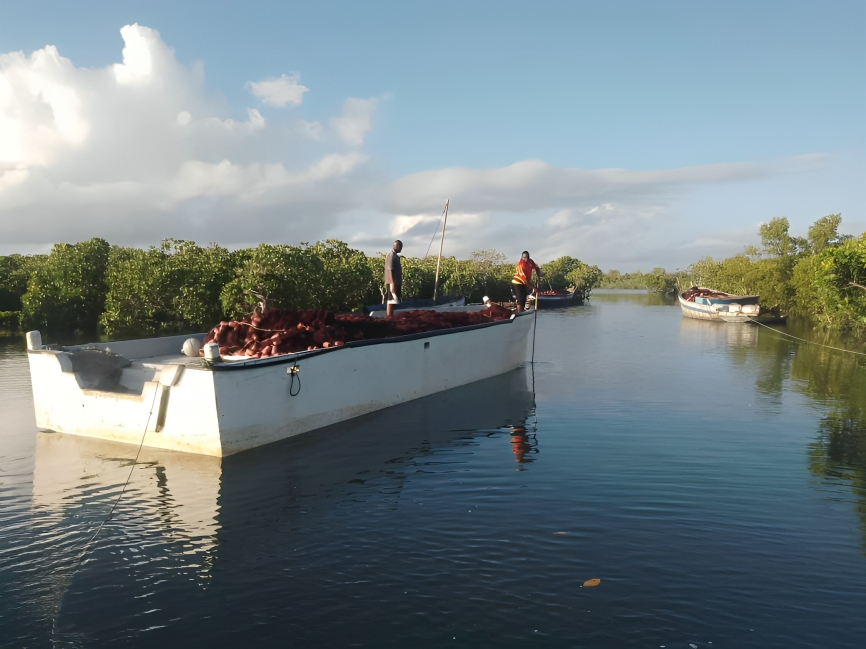
In Kilwa district, fishing is a key livelihood. Most fishers operate on a small scale, using wooden dhows (traditional fishing vessels), canoes and hand lines. Their catches, including sardines, anchovies and tuna, supply both local markets and urban centers such as Dar es Salaam.
But small-scale fishers face mounting challenges: limited access to cold storage, unreliable markets, high fuel costs, poor landing infrastructure, and competition from industrial trawlers. Climate change has further complicated their work by altering fish migration patterns and leaving them vulnerable to frequent extreme weather events.
According to Twalha, recent years have seen an increase in strong wind events that affect fishing activities. “These days, you can hardly go two months without experiencing severe winds,” he said. The fishing boat program was introduced in the 2022-2023 financial year as part of the government’s broader effort to modernize Tanzania’s marine and inland fisheries. In the first phase of the program, 160 boats were distributed among 3,163 beneficiaries across the country, at a cost of 11.5 billion shillings ($4.6 million)
In February 2025, President Hassan officially launched another round of distribution, this time 120 large fishing boats and 118 dinghies, with the Tanga region receiving 30 large vessels and 60 dinghies.
According to the fisheries ministry, eligibility for the boat loans depends on several factors: the applicant must be engaged in fishing activities, belong to a registered cooperative, and demonstrate both need and repayment capacity.
Like many others, Twalha’s Fikirini Fishman Group applied through the formal procedure; they prepared their application, submitted it to the District Fisheries Office, and then forwarded it to the Ministry of Livestock and Fisheries. Eventually, when the group’s application was approved, they were allocated a boat valued at 105 million shillings ($42,200) through a soft loan.
However, when the boats finally arrived three months after they applied, the optimism began to fade.
“When we signed the loan agreements [with the bank under the ministry of fisheries’ supervision], we hadn’t seen the boats,” Twalha said. “When they arrived, it was a shock [that] they lacked most of the features we requested.”
“These items are essential for efficient and safe fishing,” Twalha said. “Without them, we are forced to hire the missing equipment, paying about 150,000 shillings [$60] per day” — 60,000 shillings each ($24) for dinghies and lights, and 30,000 shillings ($ 12) for a generator.
The financial impact has been severe. “The irony is that these boats were meant to reduce our costs,” Twalha said. “But now, they drain more resources than our old wooden ones.”
Rising costs and mechanical problems
For many fishers, fuel consumption has become the biggest concern. According to Hamadi Yusufu, secretary of the Umoja Jimbiza Fishing group based in Jimbiza village in Kilwa, which owns one of the new boats, operational expenses have skyrocketed.
“Traveling from here to Sanje ya Kati” — an island that serves as a rest stop for fishers at sea — “used to cost about 100,000 shillings [$40] in fuel,” he said. Now, he added, the same trip costs double that amount. “The engines are too big and inefficient for our type of fishing.”
Quality problems compound the issue. Some boats reportedly developed cracks within months of being deployed.
Rashid Mohamed Mtile, another beneficiary, said his boat started leaking barely three months after entering service. “We reported the problem, and the government agreed to share the repair costs,” he said. “But that kind of damage in such a short time shows poor construction.”
Even after repairs, Mtile said, the vessels remain unreliable. “They look modern from the outside, but in practice, they are difficult to operate and maintain.”
Further, the mismatch between what fishers had requested and what was supplied extends beyond equipment. Some groups asked for longlines, a method suited to their fishing zones, but instead received a single gill net, which is inadequate to catch enough fish to sell in the local markets.
In response to Mongabay’s questions, officials at the TADB said the fishers hadn’t asked for those features, and that they give the fishers what they asked for.
Mwanaisha Abdallah Mpili, a member of one of the groups, said, “We needed at least 30 sets of nets to operate efficiently. We only got one. How are we supposed to catch enough fish to repay loans worth over 100 million shillings [$40,200]?”
For these fishers, the new boats have turned into financial traps. “The loan conditions were not clear,” Twalha of the Fikirini Fishman Group said. “We were never given a breakdown of how much the boat, engine and gear cost individually. Without that transparency, we can’t value our assets properly.”
Mounting pressure and the risk of illegal fishing
Another beneficiary, Said Mohamed Kilimba, said the financial pressure to repay loans has pushed some fishers into risky or illegal practices. “When you go out to sea knowing you must make enough to cover fuel, crew costs and loan repayments, the temptation to break the rules grows,” he said. “Some have started using small-mesh nets or fishing in restricted areas just to increase their catch. It’s not because they want to destroy the ocean, it’s because they are desperate to survive.”
He said that with higher operating costs and inconsistent catches, many groups are barely keeping up with their loan repayments. “The boats were supposed to improve our livelihoods,” Mohamed said, “but now every trip feels like a gamble. If we return with little fish, we lose money, yet the bank still expects payment.” He added that without urgent intervention, “these debts might end up driving fishers back into the same destructive habits the government was trying to end.”
Leonard Pesambili, a boat captain from Jimbiza, echoed the same concern, saying that before the new boats, they worked close to shore and shared what little they had. But now that they have loans hanging over their heads, it’s hard to sustain.
“If one group catches more, others feel forced to chase the same grounds, even if it means breaking fishing limits or going out in bad weather,” he said. “The competition has created tension among crews and increased accidents at sea.”
He said the government had good intentions for modernizing fishing, but without proper training, fuel subsidies, or fair market prices, these loans are turning brothers into rivals.
Pesambili said he fears that if repayments falter, the blame will fall unfairly on the fishers. “People will say we failed to manage our loans,” he said, “but the truth is, the project design set us up for failure.”
Bank says the boats were disbursed as agreed
Faithful Joshua, a customer service officer at the TADB, the sole loan provider for fishers under this program, said the process begins when the Ministry of Livestock and Fisheries announces available loans for boats, fish cages or seaweed farming inputs.
“Applicants must meet set criteria and submit their requests through their district directors to the ministry, which reviews and forwards them to TADB for financing,” she said.
She added that all boats are insured through the National Insurance Corporation (NIC), a pubic insurance provider. If a problem arises, the beneficiary submits a report to the TADB, which forwards it to the NIC for assessment. Once the claim is approved, the NIC compensates the TADB, which then pays the service provider for repairs.
“That was also the case for Kilwa and other boats, which were given. They were given according to the agreement, and it is very clear,” Joshua said.
“The ministry issues tenders for boat production and ensures all vessels meet national standards before distribution.”
Yet despite these procedures being in place, many fishers in Kilwa say communication between the ministry, local authorities and fishing groups was poor. They claim that crucial details about the type of boats, accessories and repayment plans were not clearly communicated before the loan agreements were signed.
A program at a crossroads
Officials have defended the program, saying it remains a critical step toward a modernized fishing industry. “We assist fishers through every stage,” said Ulimboka Ndile, the Kilwa district fisheries officer.
Boat ownership takes two forms: some owners operate as groups, while others own boats individually, Ndile said.
The TADB and the fisheries ministry said all boats must be handed over with all equipment as specified in the contracts, and that any missing items must be handled through follow-up processes.
But for the fishers in Kilwa, those assurances ring hollow. They say what they were offered on paper differs sharply from what was delivered in reality.
Twalha’s group, like others, continues to appeal to the government for the missing items. “We are not rejecting the program,” he said. “We only want the tools we were promised.”
Philip Bwathondi, a marine biologist and fisheries expert at the University of Dar es Salaam, said the Kilwa case reflects a wider challenge in Tanzania’s fisheries modernization drive. “Most of these initiatives are well-intentioned, but they often ignore the realities of small-scale fishing communities,” he said. “Vessels are sometimes designed without considering local fishing zones, fuel efficiency or the type of gear suitable for the targeted species.”
He added that such mismatches not only burden fishers financially but can also undermine sustainable fishing practices. “When fishers are forced to adapt ill-suited boats, they tend to overexploit nearby coastal areas to recover costs, which increases pressure on already fragile marine ecosystems,” Bwathondi said. “Modernization should go hand in hand with training, research and strong consultation with the communities themselves.”
Credit: Mongabay